
Edith Cowan University Churchlands Campus
The Edith Cowan University (ECU) Churchlands Campus officially operated from 1991 to 2008. However, the site's educational history dates back to the 1960s, with its origins linked to the establishment of teacher training in Western Australia in the early 1900s.
Over several decades, the Churchlands site evolved from a teachers college into a major university campus, before eventually making way for the residential development now known as Churchlands Green.
Claremont Teachers College
The origins of the Edith Cowan University Churchlands Campus can be traced back to the opening of Claremont Teachers College in 1902.
Claremont Teachers College was Western Australia's first tertiary teacher training institution and, for much of the first half of the twentieth century, was the state's principal centre for formal teacher education. The college played an important role in preparing generations of Western Australian teachers, many of whom went on to work in schools throughout metropolitan and regional areas.

As demand for teachers increased during the post-war years, teacher education expanded beyond Claremont, eventually leading to the establishment of additional facilities at Graylands, Mount Lawley and Churchlands. These developments reflected the rapid growth of Perth and the increasing demand for qualified teachers throughout Western Australia.
In 1981, Claremont Teachers College became part of the newly established Western Australian College of Advanced Education (WACAE), before becoming part of Edith Cowan University in 1991. The historic Claremont campus was later acquired by the University of Western Australia (UWA) in 2004.
Today, the heritage-listed campus remains an important educational precinct along Bay Road in Claremont. The site was entered on Western Australia's State Register of Heritage Places in 1992.
The Move to Churchlands
The expansion of teacher education facilities into Churchlands appears to have begun in the early to mid-1960s, several years before the formal establishment of Churchlands Teachers College in 1972.
Aerial photographs show that the site was largely undeveloped in 1961, while by 1965, several buildings and cleared areas were visible within the surrounding bushland. Further evidence of this early development comes from Churchlands Primary School, which commenced operations in 1965 within the college buildings.
The primary school was established to accommodate the growing population of Floreat and Churchlands, while also serving as a model school for the training of future teachers in Western Australia. This provided an opportunity for trainee teachers to observe experienced educators and gain valuable insights into classroom teaching.

Interestingly, the early development of the Churchlands campus appears to have occurred in two distinct stages. Although educational facilities were already operating at the site during the 1960s, Churchlands Teachers College was not formally established until 1972. This appears to have marked the beginning of the college's own student intakes for primary teacher training.
A report published by Churchlands Teachers College in 1973 provides valuable evidence of these early enrolments. By September that year, the college had 422 students, comprising 253 first-year students and 169 second-year students. The presence of second-year students in 1973 strongly suggests that the first formal intake commenced in 1972, coinciding with the college's official establishment.
The report also described the college's teaching facilities as being designed around principles similar to the open-area primary schools being introduced throughout Western Australia at the time. This reflected contemporary educational thinking, with an emphasis on flexible learning spaces and modern approaches to classroom teaching.
The year 1972 also marked the relocation of Churchlands Primary School from the college buildings to its present location. Despite the move, the school maintained a close relationship with the teachers college, continuing to function as a demonstration school where teachers presented lessons for college academic staff. Its teachers developed a strong reputation for their excellence in teaching and curriculum knowledge.
The college continued to develop throughout the 1970s, becoming an important centre for teacher education in Perth's western suburbs. In December 1981, it joined Claremont Teachers College, Nedlands College of Advanced Education and Mount Lawley College of Advanced Education in an amalgamation that formed the Western Australian College of Advanced Education (WACAE), colloquially known as 'Wacky'.

WACAE subsequently operated campuses at Churchlands, Claremont, Mount Lawley and Nedlands. The Churchlands campus continued to expand throughout the 1980s, with new facilities supporting a growing range of educational programs.
One of the most significant developments was the construction of a new nursing building in 1986, followed by the relocation of the WACAE School of Nursing to Churchlands in October 1988. Nursing education became an important part of the campus, with approximately 300 nurses graduating annually in its later years.

The School of Nursing remained at Churchlands until December 2007, before relocating to ECU's Joondalup Campus, where it became part of the School of Nursing and Midwifery.
The Renaming to Edith Cowan University
In 1991, WACAE was granted university status and became Edith Cowan University (ECU).
The university was named in honour of Edith Dircksey Cowan, the first woman elected to an Australian parliament. Born on 2 August 1861, Edith Cowan was a prominent social reformer who dedicated much of her life to improving the welfare of women, children, families and disadvantaged members of the community.

In 1920, Edith Cowan was awarded an Officer of the Order of the British Empire (OBE) for her contributions to public life and social reform. She was also instrumental in advancing women's legal rights in Western Australia, including reforms that opened professional opportunities previously unavailable to women.
Edith Cowan died on 9 June 1932, aged 70, and is today commemorated on Australia's fifty-dollar banknote.

During the 1990s, ECU Churchlands continued operating as an important centre for tertiary education, offering programs including teacher education, nursing and business. The campus also served as an administrative centre for the university, with its landscaped grounds and distinctive buildings forming a familiar part of the Churchlands landscape.

However, by the end of the decade, the university was preparing for a major transformation that would ultimately bring an end to its presence in Churchlands.
ECU Campus Consolidation
In 1998, Edith Cowan University developed an ambitious Campus Consolidation strategy that would ultimately lead to the closure of its Churchlands and Claremont campuses.
The strategy aimed to concentrate university activities at larger facilities, particularly Joondalup and Mount Lawley, while reducing the costs associated with maintaining several separate metropolitan campuses. It also reflected the rapid population growth occurring in Perth's northern suburbs and ECU's desire to establish a stronger presence in the Joondalup region.
An important part of the strategy involved using proceeds from the disposal and redevelopment of the Churchlands and Claremont properties to help finance new university facilities.
The foundations for this strategy had been laid in 1997, following the appointment of Professor Millicent Poole as ECU Vice-Chancellor. In July that year, Professor Poole presented a series of papers to the ECU University Council examining the institution's future direction. These raised fundamental questions about whether ECU needed to retain all its existing campuses and whether greater emphasis should be placed on developing Joondalup.

The university subsequently undertook an extensive strategic planning process, involving consultations with staff, students and external stakeholders. By July 2000, Professor Poole had publicly outlined the university's plans to leave Churchlands and Claremont, explaining that consolidation would allow ECU to expand its Joondalup campus.
At the time, ECU operated five campuses - Churchlands, Claremont, Mount Lawley, Joondalup and Bunbury. In December 2000, the Western Australian Government announced details of a six-year, $136 million campus consolidation program.
The proposed changes included transferring approximately 3,000 students and 700 staff to Joondalup, together with a further 1,000 students and 150 staff to Mount Lawley. These figures related to the broader university consolidation program rather than transfers exclusively from Churchlands.
The program represented one of the most significant restructurings in ECU's history and would eventually transform the university's geographical footprint across Perth.
The $40 Million Churchlands Agreement
A major milestone occurred in December 2001, when Premier Geoff Gallop announced an agreement between the Western Australian Government and Edith Cowan University.
Under the arrangement, the State Government would grant ECU freehold title over its approximately 19-hectare Churchlands property. This meant that ECU would gain full legal ownership of the land, rather than simply having the right to use it for educational purposes. Importantly, this would allow the university to sell the property for redevelopment, with the land expected to generate up to $40 million. These proceeds would help fund the expansion of ECU's Joondalup and Mount Lawley campuses.
The agreement also required consultation with local residents regarding the future of the Churchlands property, including the childcare centre operating on the site.
In 2003, ECU relocated its corporate headquarters from Churchlands to Joondalup, coinciding with the opening of a new Chancellery Building at the Joondalup Campus. This represented a significant milestone in the university's consolidation strategy, establishing Joondalup as its principal administrative centre several years before the final closure of the Churchlands Campus in 2008.
Planning for the Closure of Churchlands
By 2003, the Western Australian Planning Commission had commenced the process of changing the Churchlands Campus zoning from University Purposes to Urban.
The City of Stirling had also agreed to pursue rezoning the land for mixed residential development, with the necessary planning amendments expected to be finalised during 2004. ECU's 2003 Annual Report provides an interesting insight into the original redevelopment timetable.
At that stage, preliminary site works were anticipated for September or October 2004, with staged demolition of some campus buildings expected to commence in early 2005. The university anticipated completely vacating the Churchlands Campus in 2007, although this timetable would subsequently be extended.
Redevelopment Begins
By 2006, the redevelopment had progressed from planning into physical works.
ECU's 2006 Annual Report confirmed that site development works commenced at Churchlands in the middle of that year, with the first residential land sales planned for early 2007. Meanwhile, major construction projects were underway at Joondalup and Mount Lawley to accommodate university activities relocating from Churchlands.
These included a new Library and Technology Centre at Joondalup, a Health and Wellness Building, and new teaching facilities. At Mount Lawley, plans were progressing for a new Business and Law Building.
These projects demonstrated how the redevelopment of Churchlands was directly connected to the expansion of ECU's remaining metropolitan campuses.

The Final Closure in 2008
The Edith Cowan University Churchlands Campus formally closed in July 2008, bringing to an end several decades of tertiary education at the site.
The remaining university activities were relocated to ECU's Joondalup and Mount Lawley campuses. Although the original consolidation strategy had anticipated an earlier departure, the final closure occurred approximately ten years after the strategy was developed in 1998.
Residential construction at Churchlands Green began around 2007-2008, with new homes progressively replacing the former university buildings and grounds. By 2015, the Churchlands Green redevelopment was largely complete, concluding a transformation that had begun with the university's consolidation plans nearly two decades earlier.

ECU Churchlands Legacy
The closure of the Edith Cowan University Churchlands Campus marked the end of more than four decades of educational activity at the site.
During this period, the campus educated generations of teachers, nurses, business professionals and other graduates who went on to contribute to communities throughout Western Australia. Although most of the former campus buildings have disappeared, the site's educational history has been preserved through a collection of sculptures, memorials and public spaces within Churchlands Green.
These include academic-inspired artworks, stainless steel commemorative plaques, concrete sculptures representing stacked books, and a refurbished amphitheatre associated with the former campus.

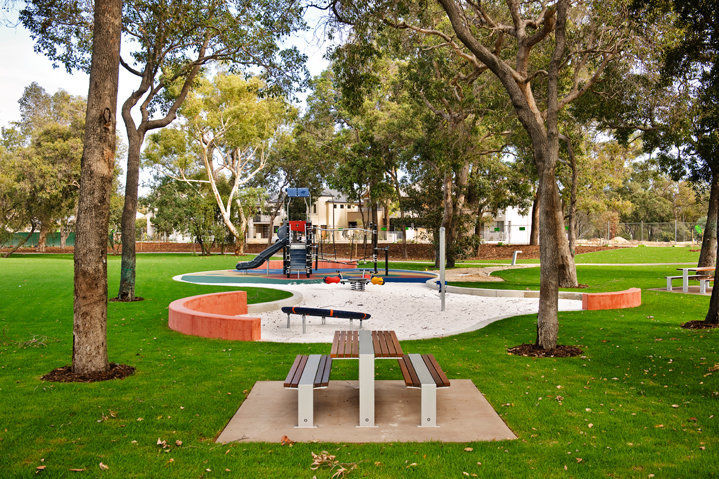
The sculptures and memorials can be found in and around Edith Cowan Reserve, the principal public open space within Churchlands Green. They provide an important reminder of the site's educational past and the many students and staff who were associated with the campus over the decades.
Today, the former university grounds have been transformed into a residential neighbourhood, with landscaped streets, modern homes and public parkland occupying land once used for teaching, research and university administration. The transformation from a tertiary education campus into Churchlands Green represents one of the most significant changes in the suburb's modern history.
Edith Cowan University has also continued to evolve. In February 2026, ECU opened its new City Campus in central Perth, bringing together creative industries, business, law and technology programs in a major new educational precinct.

While the Churchlands Campus has long since disappeared, its legacy remains an important part of the history and identity of Churchlands.
Historical References
Churchlands Primary School (n.d.). Our History.https://www.churchlandsps.wa.edu.au/our-school/our-history/
Churchlands Teachers College (1973). A Submission for the Award of a Diploma of Teaching. Churchlands, Western Australia: Churchlands Teachers College.
City of Stirling (n.d.). Churchlands.https://www.stirling.wa.gov.au/city-and-council/your-local-suburb/churchlands
City of Joondalup (2000). Council Meeting Minutes, 11 July 2000.https://api.joondalup.wa.gov.au/files/councilmeetings/2000/CJ000711_MIN.pdf
Edith Cowan University (2003). Annual Report 2003.
Edith Cowan University (2006). Annual Report 2006.
Government of Western Australia (2000). Claremont Teachers' College to be redeveloped as an education precinct, 29 December 2000.
Government of Western Australia (2001). State's second biggest university to move headquarters to northern suburbs, 16 December 2001.
Spillman, K. (2006). Raising Edith: The Transformation of a New Generation University: Edith Cowan University 1995-2005. Edith Cowan University, Mount Lawley, Western Australia.https://ro.ecu.edu.au/ecuworks/6742
Callaghan, R. (2012). Edith Cowan University 1991-2011: The Journey So Far. Edith Cowan University, Perth, Western Australia.https://ro.ecu.edu.au/ecuworks2012/837
Wikipedia contributors (2026). Churchlands, Western Australia. Wikipedia, The Free Encyclopedia.https://en.wikipedia.org/wiki/Churchlands,_Western_Australia
Parliament of Australia (2016). Edith Cowan University. House of Representatives, Statements by Members, 16 March 2016. Speech by Ian Goodenough MP.Available at: https://www.openaustralia.org.au/debate/?id=2016-03-16.46.2


Comments