
Churchlands - History, Lifestyle & Local Profile
Churchlands is an established suburb of Perth in Western Australia, located approximately 8 kilometres north-west of the CBD and governed by the City of Stirling.
The suburb of Churchlands takes its name from its historical ownership by the Catholic Church in the late 1800s and early 1900s.
Long recognised for its strong education focus, proximity to Herdsman Lake, and premium residential estates, Churchlands has evolved from early farming land into one of Perth’s most desirable and tightly held suburbs.

Churchlands at a Glance 📍
Distance to CBD: Approximately 8 km north-west of Perth’s CBD
Local government: City of Stirling
Post code: 6018
Education: Home to highly regarded schools
Natural assets: Adjacent to Herdsman Lake and close to popular beaches
Housing: Established family homes, townhouses, and apartments

History of Churchlands
First European Land Grants
European settlement in the Churchlands area began in the early 1830s, during the early years of the Swan River Colony. At this time, land was allocated to early settlers Henry Trigg and the Hokin family as part of the colony’s initial land distribution.
While both parties were associated with their respective landholdings from the 1830s, formal Crown Grants for Swan Locations ‘An’ (Trigg) and ‘Ao’ (Hokin) were issued on the 18th of October 1842 under Governor John Hutt, during the reign of Queen Victoria. Both grants comprised 200 acres.
These grants established the first European landholdings across what would later become the suburb of Churchlands.

Over time, both parcels were consolidated under a single owner. William Strickland acquired Swan Location ‘Ao’ in 1860 and later purchased Swan Location ‘An’ in 1874, bringing the two original land grants together for the first time. This consolidation marked an important step in the area’s transition from isolated agricultural holdings to a unified landholding. In 1891, Strickland sold a substantial portion of this land to Perth’s Roman Catholic Bishop, Matthew Gibney. This transaction established a long association between the Catholic Church and the area, which would later influence the suburb’s identity and name.

In 1920, the Western Australian State Government acquired large areas of low-lying land around Herdsman Lake from the Catholic Church as part of broader land settlement and drainage initiatives. These acquisitions paved the way for subsequent subdivision schemes and landscape modification.
By 1924, the name “Churchlands” was appearing in local records, reflecting the fact that the area had previously been owned by the Catholic Church. The name has remained ever since and links the suburb’s identity to its early Church ownership. Subdivision of Herdsman Lake
Following the State Government’s acquisition of Church-owned land around Herdsman Lake in 1920, the area entered a new phase of planned development under a Soldier Settlement Scheme.
As part of this scheme, more than 1,000 acres of low-lying swamp land encompassing the lake bed and its fringes were subdivided into agricultural and residential holdings. Extensive drainage works were undertaken to make the land usable, including the construction of a 3.5-kilometre tunnel linking Herdsman Lake to the ocean near Floreat Beach.
Despite significant public investment throughout the 1920s, the initial subdivision proved unsuccessful due to poor soil conditions, persistent flooding, and impractical lot sizes.
In a second attempt to encourage settlement, 40 timber cottages were constructed around the lake’s perimeter in 1930. The only surviving example, Settler’s Cottage on Pearson Street, remains preserved by the National Trust as a rare reminder of Depression-era life in the area.

While the land continued to be used for grazing and market gardening into the mid-20th century, the settlement scheme was ultimately abandoned. The development of the Herdsman Lake Concept Plan in 1976, led by the Metropolitan Regional Planning Authority, marked a turning point and initiated the lake’s long-term restoration as a protected wetland.
Police Horse Stables In 1938, the State Government relocated the Department of Agriculture’s Heavy Horse Stables from Shenton Park to what is now Churchlands. The new site, located along Herdsman Parade (today’s Pearson Street), supported working horses used in road construction and public works across the metropolitan area. By the early 1950s, the facility had taken on a new role as the Wembley (Churchlands) Police Horse Stables, following the relocation of the mounted police unit from the Central Police Station on Roe Street. From 1953 until 1976, the stables played an important role in housing, training, and deploying mounted police throughout Perth, including for patrols, ceremonial duties, and crowd control.

During World War II (1939–45), additional stables were constructed on Cromarty Road near the present-day Churchlands Primary School. These were built as a precautionary measure in case central Perth facilities were damaged during air raids, reflecting the strategic importance of the mounted unit at the time.
The Churchlands police stables closed in 1976, when mounted police operations were relocated to Murdoch University. While only limited physical evidence of the stables remains today, the site represents a distinctive chapter in Churchlands’ history, linking the suburb’s rural past with its role in Western Australia’s policing and public service heritage. Edith Cowan University
Education has been central to Churchlands’ identity for decades. In the 1950s, the Claremont Teachers College expanded to include a new campus at Churchlands, reflecting the growing demand for teacher training in Western Australia.
In 1972, the site became the Churchlands Teachers College and later formed part of the Western Australian College of Advanced Education (WACAE). When WACAE achieved university status in 1991, it became Edith Cowan University, with the Churchlands campus serving as the university’s headquarters for many years.
The ECU Churchlands Campus closed in 2008 as part of a broader campus consolidation strategy. The 20-hectare site was subsequently redeveloped into the award-winning Churchlands Green estate, now home to more than 300 dwellings.

The development incorporates Edith Cowan Reserve and a series of academic-inspired sculptures, ensuring the site’s educational legacy remains embedded in the suburb’s modern landscape.
Geography and Lifestyle
Location and Surroundings
Churchlands occupies a highly desirable position in Perth’s western suburbs, combining proximity to the CBD with immediate access to natural open space and coastal amenities.
Neighbouring suburbs include Wembley Downs, Woodlands, Floreat, and Wembley.
The suburb is bordered by:
East: Herdsman Lake (Parkwater Gardens, The Foreshore, Lakeside Road, Selby Street)
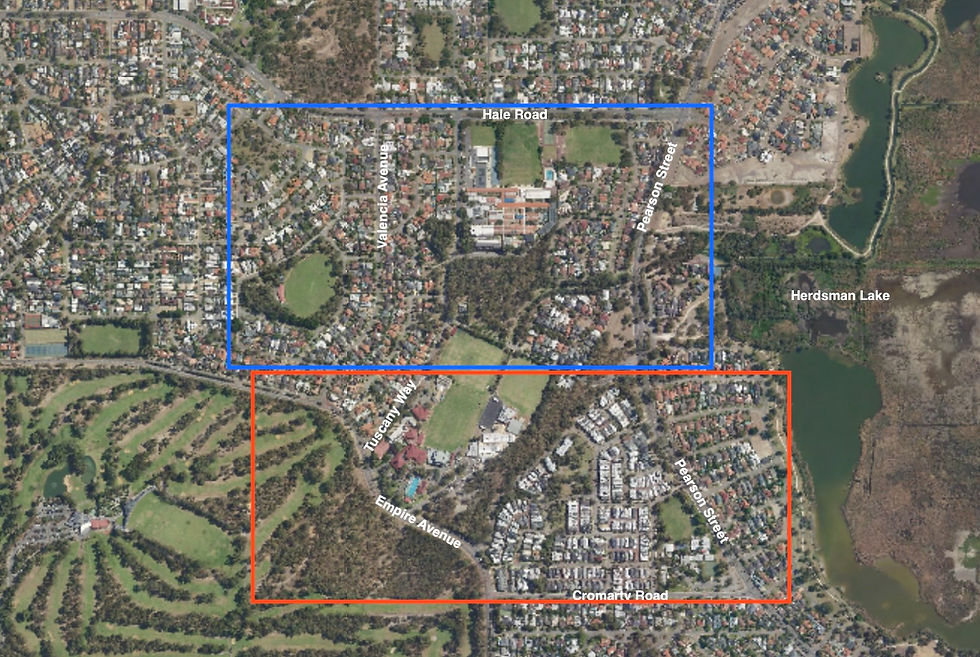
North: Hale Road
West: Valencia Avenue
South: Empire Avenue, Cromarty Road, and Pearson Street

This location places Churchlands approximately 8 km north-west of Perth’s CBD, while still feeling insulated from heavy traffic and high-density development. The suburb’s eastern edge is defined by Herdsman Lake Regional Park, creating a natural buffer and a strong sense of openness that is uncommon so close to the city.
Transport and Connectivity
Churchlands is well connected to Perth’s road and public transport network, with key access routes including Hale Road, Empire Avenue, and Pearson Street. These connections provide direct links to surrounding suburbs, the Perth CBD, and nearby coastal areas.
Public bus services operate along the suburb’s boundaries and nearby arterial roads, offering connections to the CBD, Subiaco, and surrounding activity centres. For commuters, travel time to Perth’s CBD is typically around 15–20 minutes by car outside peak periods.
Local Attractions and Lifestyle
Churchlands offers a lifestyle centred around outdoor recreation, convenience, and access to some of Perth’s best natural and leisure destinations.
Herdsman Lake Regional Park lies immediately east of the suburb and is a major lifestyle asset, providing walking and cycling trails, playgrounds, birdwatching, picnic areas, and expansive green space used daily by local residents.

Perth’s coastline is also close at hand. Floreat Beach and City Beach are both within a short drive, offering swimming beaches, coastal walking paths, and beachfront cafes.
Other nearby attractions include:
Bold Park – one of Perth’s largest inner-city bushland reserves
Wembley Golf Course – a popular public golf facility
Jackadder Lake Reserve – local green space and walking paths
Bold Park Aquatic – indoor and outdoor pools and fitness facilities
Together, these amenities support an active, outdoor-focused lifestyle that is a defining feature of Churchlands.
Shopping, Dining, and Entertainment
Despite its quiet residential character, Churchlands is well serviced by shopping and dining precincts ranging from local convenience centres to major retail hubs.
The closest shopping area is Herdsman Central, located just over a kilometre from most parts of the suburb. It provides everyday services and specialty retailers, with The Herdsman Market as its standout attraction.
Originally opened in the late 1970s as the Herdsman Growers Market, The Herdsman Market has evolved into one of Perth’s premier gourmet food destinations, known for premium produce, artisan bakery goods, fresh seafood, flowers, and barista coffee.

A short drive south-west brings residents to Floreat Forum, Perth’s first American-style shopping centre, opened in 1965. The centre was significantly upgraded in the early 2000s and continues to serve as a major local retail and dining hub.
Just 3 kilometres north lies Westfield Innaloo, one of Perth’s largest shopping and entertainment complexes, featuring over 170 stores, major supermarkets, and the Innaloo Cinema Centre.
Collectively, these centres give Churchlands residents access to everyday essentials, specialty food shopping, and major retail and entertainment options - all within a five-minute drive.
Residential Areas of Churchlands
From the 1980s onwards, Churchlands transformed into a residential suburb through a series of estates.
Old Churchlands (1980s)
Old Churchlands was one of the first residential areas developed within the suburb. It is located west of Churchlands Senior High School and Newman College, bounded by Lucca Street and Tuscany Way to the east, Valencia Avenue to the west, Hale Road to the north, and Empire Avenue to the south.
Several streets in this part of Churchlands are named after European cities, including Valencia, Tuscany, Lucca and Mantua. While these names may suggest a Mediterranean influence, there is no clear evidence of an Italian or Spanish migrant enclave in the area. Instead, the naming reflects a common mid-20th-century planning trend in Perth, where European place names were used to add character and identity to new residential subdivisions.
Aerial photographs show that Old Churchlands was largely complete by 1983.

Floreat Waters Estate (1980s)
The Floreat Waters Estate is named after Floreat Waters, a deep-water section of Herdsman Lake identified as part of the Herdsman Lake Concept Plan in 1976.

The estate is located between the western edge of Herdsman Lake and Pearson Street in Churchlands. Aerial photographs and planning records indicate that residential development occurred primarily during the early to mid 1980s.
Street naming within the estate follows a bird theme, with examples including Goldfinch Avenue, Swallow Court and Falcon Avenue. The area also includes The Lane, a more exclusive enclave of homes that incorporates the Floreat Waters Tennis Courts.
Churchlands Private Estate (1980s)
The Churchlands Private Estate is located directly east of Churchlands Senior High School and is accessed via Churchlands Avenue off Hale Road. The estate’s name is generally understood to reflect its secluded layout, characterised by limited through-traffic and multiple cul-de-sacs.

The western boundary of the estate is marked by a distinctive red brick fence visible from Pearson Street. Internally, the estate follows a ring-road design with a series of branching cul-de-sacs, with brick-paved roads that further distinguish it from surrounding areas and contribute to its quiet, enclosed residential character.
Aerial photography indicates that development of the Churchlands Private Estate was largely completed by the late 1980s.
Floreat Lakes Estate (1990s - present) The Floreat Lakes Estate is accessed via Bishop Hale Way and, like the Floreat Waters Estate, is located between Herdsman Lake and Pearson Street. The estate takes its name from the Floreat Lakes section of water within Herdsman Lake.

Street names within the estate follow a distinct church-related theme, with examples including St David’s Rise, Parish Lane, All Saints Way and St Oswalds Rise. This naming is generally understood to reference the area’s historical association with Church ownership rather than reflecting a specific religious community.
Development of Floreat Lakes commenced in the early 1990s and has continued in stages over time. While the majority of the estate is now established, limited land releases have occurred periodically, with remaining blocks marketed through The Foreshore at Floreat Lakes sales office.
Abbey Brook Estate (2000s)
Abbey Brook Estate is a small residential development completed in the early 2000s, located immediately north-east of Newman College. Accessed via Dolomite Court, the estate follows a quiet, no-through-road design similar to nearby Churchlands Private Estate, contributing to its secluded and residential character.
The estate is visually distinctive, featuring teal-coloured fence detailing and mature Liquidambar trees that line several streets.
Abbey Brook Estate takes its name from the narrow watercourse that runs along its north-western boundary, adjacent to Abbeybrook Reserve. While it appears today as a naturalised stream, historic aerial imagery from the 1930s suggests this waterway was originally an engineered drainage channel rather than a natural brook. It likely formed part of the broader drainage works undertaken in the early 1920s to manage water levels around Herdsman Lake.
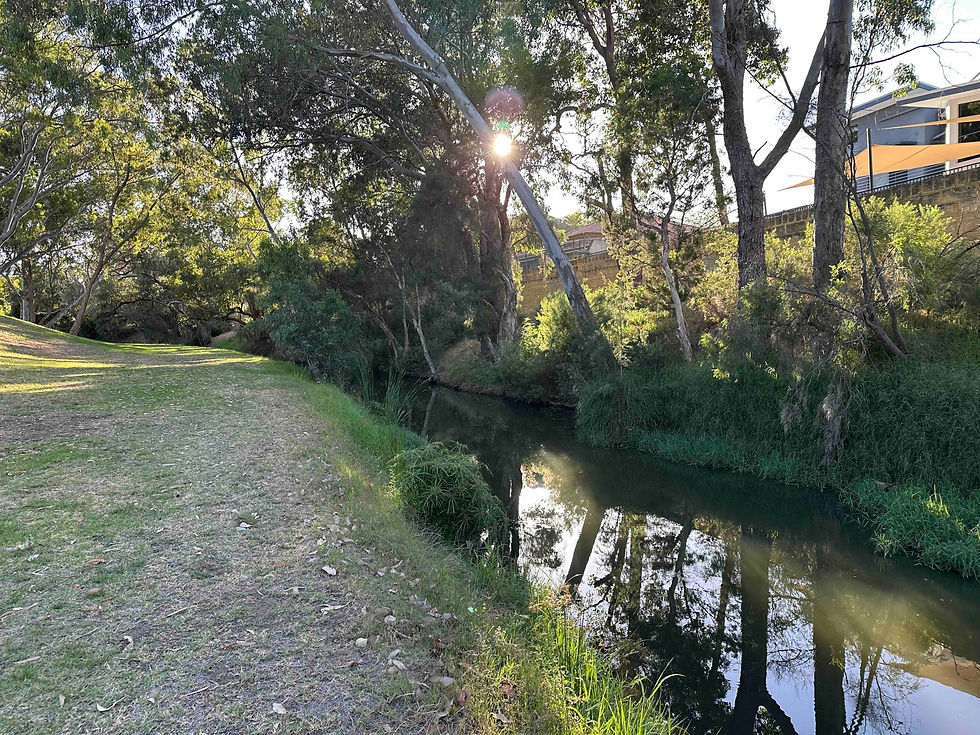
Part of the Abbey Brook Estate also occupies land formerly associated with the Churchlands Police Horse Stables, adding another historical layer to what is now a modern residential pocket.
Churchlands Green (2010s)
Churchlands Green contains over 300 dwellings and is located on the former Edith Cowan University (ECU) Churchlands Campus site. The estate sits to the west and north of Churchlands Primary School.

The estate takes its name from the surrounding bushland and greenery, including an area known as the Churchlands Bushland, which remains an important natural feature of the development.
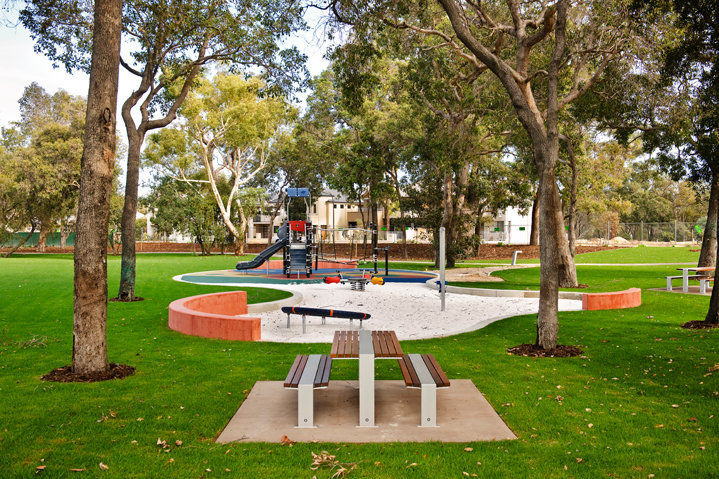
At the heart of the estate is Edith Cowan Reserve, the main public open space for Churchlands Green. The reserve includes a children’s playground, fitness and walking paths, barbecue and picnic facilities, and shaded lawn areas, and serves as a key recreational and social hub for residents.
Churchlands Green has multiple access points and is characterised by contemporary, low-maintenance homes. Throughout the estate are academic-inspired sculptures that acknowledge and celebrate the site’s former role as an educational campus.
Construction commenced around 2006 and was largely complete by 2015. The estate also features high-quality stone masonry, carried out by Stonecivil, one of Western Australia’s most respected stonemasonry firms.
Smaller areas with Churchlands
Smaller clusters of housing in Churchlands include:
Floreat Village – apartment buildings on Pearson Street
Waterway Court – mix of apartments and townhouses
Kenwood Court – Over 50 townhouses on Flynn Street
Floreat Gardens – 40 townhouses on Flynn Street
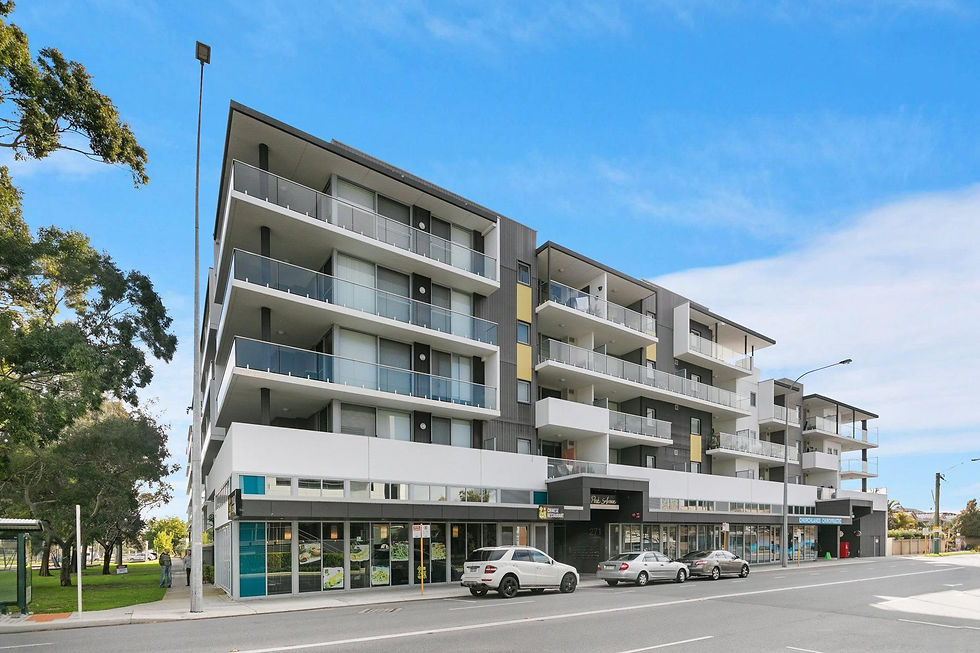
Park Avenue – 93 apartments with ground floor commercial spaces
Notable Landmarks in Churchlands
Settler's Cottage
Settlers Cottage is one of the most historically significant surviving buildings in Churchlands and a rare reminder of the area’s early settlement period around Herdsman Lake.
Built in the early 1930s, the simple timber cottage was one of 40 identical homes constructed by the State Government as part of efforts to encourage settlement following the subdivision and drainage of land around the lake.

While many of the surrounding cottages were later removed as the area evolved, Settlers Cottage was retained and is now preserved as a heritage site. Located on Pearson Street, it stands as a tangible link to the hardship faced by early settlers during the Depression era and to the broader story of Churchlands’ transition from marginal farmland to a well-established suburb. Statue in Herdsman Lake
Located on a small island within the lake at Floreat Waters (Herdsman Lake) is a distinctive classical sculpture depicting Eirene, the Greek goddess of Peace and Plenty, accompanied by allegorical figures representing labour and family. While its surface appears aqua or teal today, the statue is cast in bronze and has developed its green-blue patina naturally over time.

The sculpture was created by renowned artist Pietro Porcelli and originally stood atop the historic AMP Chambers building on St Georges Terrace, completed in 1915. When the building was demolished in 1972, a time capsule was discovered inside the statue containing the names of the four men who erected it in October 1914. The statue was preserved and later relocated to Floreat Waters in the 1990s, where it was installed as a piece of public art.
Today, the statue has become a recognisable landmark around Herdsman Lake, linking Perth’s early architectural history with the modern residential landscapes of Churchlands and its surrounding estates.
Grand Manor on Bishop Riley Way
One of the most distinctive residences in Churchlands is the large, manor-style house on Bishop Riley Way within the Floreat Lakes Estate. With its castle-like brickwork, steep gables, decorative ironwork and walled frontage, the house stands out sharply from the surrounding streets and has long attracted local curiosity.

The origins of the house are not documented publicly, but according to propertyvalue.com.au it was built in the year 2000. Local speculation has often linked the property to Terry Jackson, founder of the Kreepy Krauly brand and a key figure in the development of the Floreat Lakes Estate through one of his companies. Given Jackson’s known involvement in the estate’s development, and the house’s prominent position within it, this association is frequently raised.
Over time, the house has become something of a local landmark. While rumours and anecdotes continue to circulate about its ownership and use, no definitive public information has emerged. Its scale, architecture and air of mystery nevertheless make it one of the most recognisable and talked-about homes in Churchlands.
Edith Cowan Reserve
Edith Cowan Reserve is the main public open space within the Churchlands Green estate and occupies part of the former Edith Cowan University Churchlands Campus. Named after Edith Cowan, Western Australia’s first female parliamentarian, the reserve reflects the site’s long-standing connection to education and public life.

The reserve includes a children’s playground, open lawn areas, walking and fitness paths, and barbecue and picnic facilities, making it a popular space for families and everyday recreation.
As part of the Churchlands Green redevelopment, Edith Cowan Reserve helps preserve open space within a higher-density residential area and contributes to the suburb’s strong lifestyle appeal. Schools and Education in Churchlands
Education has long been central to Churchlands’ identity and remains one of the suburb’s most defining features. The area is home to a concentration of highly regarded public and independent schools, making it one of Perth’s most sought-after suburbs for families.
Churchlands Primary School
Churchlands Primary School is a well-regarded public primary school catering from Kindergarten to Year 6. The school has a strong local reputation and serves much of the surrounding Churchlands and Floreat community.

Churchlands Senior High School
Churchlands Senior High School is one of Western Australia’s most prominent public secondary schools. Known for its strong academic performance, renowned music program, specialist offerings, and broad catchment appeal, it has played a major role in shaping Churchlands’ family-oriented character for decades.
Newman College
Newman College is a Catholic co-educational school catering for students from Year 3 to Year 12. Located on the western edge of Churchlands, the college is closely connected to the suburb’s history and community life.
Hale School
Hale School, one of Perth’s oldest and most prestigious independent boys’ schools, is located adjacent to Churchlands. Its proximity adds to the suburb’s appeal for families seeking access to elite independent education.

This strong educational presence reflects the suburb's history as a centre for teacher training and higher education, from the former Churchlands Teachers College to the Edith Cowan University campus. Together, these schools continue to underpin the suburb’s reputation as one of Perth’s leading education precincts.
Real Estate and Demographics
Churchlands has evolved into one of Perth’s most desirable western suburbs, offering a blend of premium homes, strong community values, and exceptional access to schools, open space, and the coast.
Real Estate Overview
Most homes in Churchlands were built after the 1980s, with a focus on family living and low-maintenance design. The suburb features a mix of large family residences, modern townhouses, and some medium-density apartments around Waterway Court and Herdsman Central.
Churchlands’ real estate values reflect its premium status. As of November 2025, the median house price sits around $2.2 million, while the median unit/apartment price is approximately $605,000. Demand remains strong due to the suburb’s proximity to the Perth CBD (8 km), top-performing schools, and coastal lifestyle.

The median weekly rent is around $1,050 (house) and $650 (unit), and around 72% of properties are owner-occupied - a sign of long-term residents and family stability.
Demographics Snapshot
According to the 2021 Census, Churchlands had a population of 3,638 residents, representing steady growth since 2016. The suburb’s population is diverse and highly educated, with many residents employed in professional and managerial roles.
Key statistics from the 2021 Census include:
Median age: 41 years
Gender split: 48.2% male, 51.8% female
Average household size: 2.6 people
Median weekly household income: $2,314
Average motor vehicles per dwelling: 1.9
Population growth (2016–2021): +7.4%
Cultural diversity: 61.6% of residents have at least one parent born overseas
The suburb is primarily made up of couples with children, consistent with its reputation as a family-oriented area with outstanding access to education.
Property Ownership
Home ownership is high, with approximately 72.6% of homes either fully owned or mortgaged, while 25% are rented. The majority of dwellings are separate houses, with semi-detached and apartment living being less common.
Age Distribution
Churchlands has a balanced age profile, with a strong representation of families and established professionals.
Children (0–14 years): 17%
Youth (15–24 years): 11%
Adults (25–44 years): 26%
Middle-aged (45–64 years): 29%
Seniors (65+ years): 17%

This distribution reflects a stable, family-oriented community with a mix of young families and long-term residents who have lived in the area for decades.
State Electorate and Parliamentary Representation
Churchlands falls within the Churchlands electorate for the Parliament of Western Australia. The electorate includes all or part of Churchlands, City Beach, Doubleview, Floreat, Glendalough, Innaloo, Osborne Park, Scarborough, Wembley, Wembley Downs, West Leederville and Woodlands.
At a local level, Churchlands is represented within the City of Stirling local government area, linking state parliamentary representation with municipal planning, community services, and local infrastructure that shape day-to-day life in the suburb.
Churchlands Today
Today, Churchlands represents the blending of heritage and modern living. From its roots in early settlement and Catholic landholdings to its transformation through educational institutions and premium estates, it has become one of Perth’s most desirable suburbs.
Herdsman Lake, Settler’s Cottage, and the surrounding residential estates together showcase the suburb’s unique character: a place where history, education, and lifestyle meet.


Comments